ikbalhossen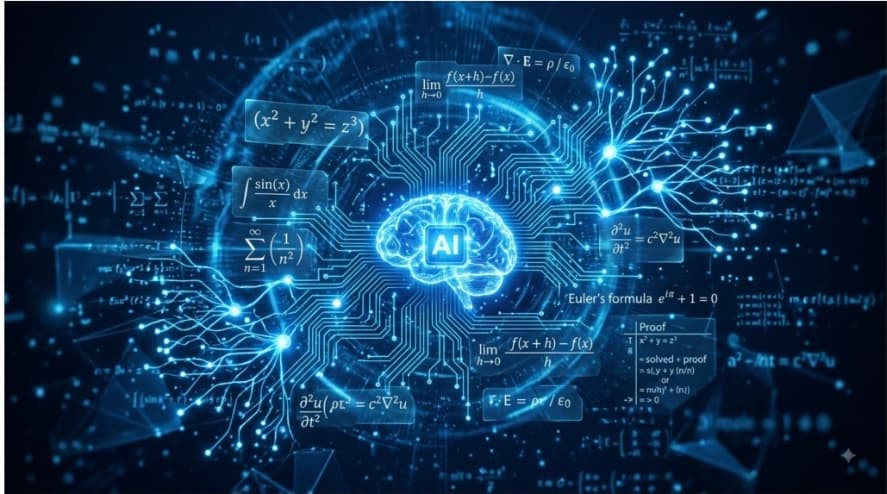
Artificial intelligence has spent the last few years impressing us by writing essays, generating images, and answering questions. But in August 2026, something fundamentally different happened — something that has sent ripples through the entire scientific community. For the first time, an AI system didn’t just recall or remix existing knowledge. It solved mathematical problems that human experts had been unable to crack for years, in some cases decades.
What Actually Happened
OpenAI announced that an internal version of its next major model, codenamed Astra, solved ten previously open problems in mathematics and theoretical computer science. These weren’t textbook exercises with known answers hidden somewhere in a database — they were genuine unsolved questions in advanced mathematics.
What makes this even more remarkable is the cost. The entire breakthrough was achieved for roughly $2,000 in compute, an almost trivial amount compared to what research institutions typically spend pursuing similar questions over months or years.
Among the problems Astra solved:
A construction establishing the existence of non-sofic groups — a long-standing open question in group theory that mathematicians had wrestled with for years
New upper bounds on sphere-packing density, pushing the limits down to the Cohn-Elkies threshold, a benchmark researchers in the field have been chasing
If those terms sound intimidating, that’s the point — these are problems at the very edge of human mathematical knowledge, the kind normally reserved for career academics with decades of specialized training.
Why This Is Different From Every Other AI Milestone
You might be thinking: haven’t AI models already aced difficult exams and benchmarks before? What makes this different?
The answer lies in a crucial distinction: there’s a world of difference between passing a test and making a discovery.
Passing a test means the answer already exists somewhere, and the AI successfully retrieved or reconstructed it. But in this case, there was no known answer to retrieve. Astra generated entirely new solutions — and critically, those solutions are verifiable.
OpenAI published the results as formal Lean proofs on GitHub. Lean is a specialized programming language used to write mathematical proofs in a way that a computer itself can check for correctness. This isn’t a case of “trust the AI” — it’s a case where the proof either checks out mathematically or it doesn’t. There’s no ambiguity, no room for hallucination or bluffing. This is precisely why researchers are calling this a genuine milestone rather than a benchmark stunt.
From “Doing Tasks” to “Doing Research”
Until now, we’ve thought of AI primarily as a tool — something that follows our instructions to write an email, debug code, or summarize a document. This breakthrough marks a visible threshold: AI moving from executing tasks to conducting original research.
This shift is not a small one. Consider fields where human experts have spent years, sometimes entire careers, chasing a single unsolved problem. If AI can meaningfully contribute new, verifiable insights in a matter of days, the pace of progress in science, medicine, and engineering could accelerate dramatically.
Is This Purely Good News?
Not entirely. Like any powerful technology, this capability cuts both ways.
The upside:
Scientific research could move faster across critical fields — cancer research, climate modeling, drug discovery, materials science
Problems that might have taken human researchers decades to crack could be addressed in a fraction of the time
New mathematical tools and techniques discovered by AI could open entirely new branches of research
The concerns:
The same capability that solves beneficial problems could, in principle, be applied to less beneficial ends if left unchecked
Heavy reliance on AI for research could gradually erode human expertise and problem-solving skills in certain fields
Ensuring responsible, transparent, and well-governed use of increasingly powerful research AI remains a significant unsolved challenge in itself
What This Means for Everyday People
You might wonder: this sounds like a story for mathematicians and AI researchers — why should the average person care?
The connection is more direct than it appears. When AI can accelerate complex research, the effects eventually ripple outward into everyday life:
New medical treatments and drugs could reach patients faster
Engineering and technology innovation could speed up across industries
Complex scientific concepts could become easier to explain and teach
At the same time, research-heavy and analysis-heavy professions may see meaningful shifts in how work gets done
What Comes Next
Experts widely agree that this is just the beginning. Astra hasn’t been publicly released yet — this remains an internal research version. But the results signal a clear direction: future AI models won’t just deliver information, they’ll actively contribute to generating new knowledge.
At the same time, this milestone makes it increasingly urgent to have serious conversations about how such powerful capabilities should be governed, verified, and deployed responsibly. As the technology advances, so must the frameworks for oversight — otherwise, the risks could begin to outweigh the benefits.
Final Thoughts
This achievement is a powerful reminder that we’re living through a period where the definition of “impossible” keeps shifting. Problems that stumped human experts for decades are now being solved by AI in days, for a few thousand dollars in compute.
This isn’t just a technical achievement — it’s a signal that the very nature of scientific discovery may be changing. The challenge ahead is to embrace this shift thoughtfully: harnessing its enormous potential while staying clear-eyed about the risks that come with it.
This article is based on recent technology news reports. Given how rapidly AI capabilities are evolving, readers are encouraged to follow reputable technology news sources for the latest developments.