ikbalhossen
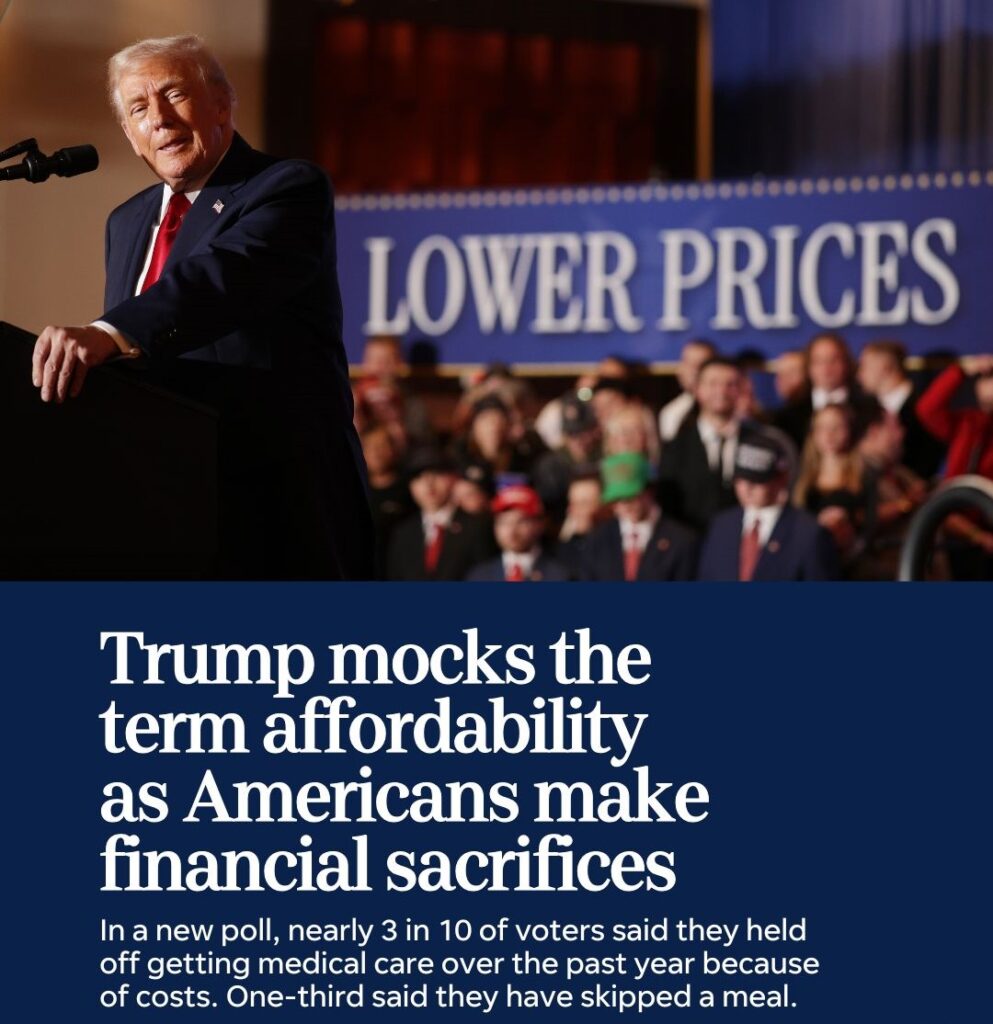
MOUNT POCONO, PA – President Donald Trump launched his highly anticipated “affordability tour” on December 9, 2025, at the Mount Airy Casino Resort in Pennsylvania, but instead of addressing the financial pain gripping millions of American families, he spent much of his 95-minute speech mocking the very concept of “affordability” as a Democratic invention. Speaking before a crowd of supporters under banners proclaiming “Lower Prices Bigger Paychecks,” Trump dismissed concerns about rising costs as overblown, insisting that prices are “coming down tremendously” and grading his own economic record an “A-plus-plus-plus-plus-plus.”
“They say, ‘Affordability.’ And everyone says, ‘Oh, that must mean Trump has high prices.’ No, our prices are coming down tremendously,” Trump quipped, drawing cheers from the audience. He stopped short of calling it an outright “hoax” – a term he’s used before – but implied the word is a partisan weapon wielded by opponents to undermine his administration’s successes. 0
Yet, just two days later, a starkly contrasting poll released on December 11 by the progressive think tank The Century Foundation – shared exclusively with USA TODAY – paints a grim portrait of everyday Americans making heartbreaking sacrifices to make ends meet. The survey of 1,426 registered voters reveals that financial insecurity is rampant, with working-class families – Trump’s core political base – hit hardest by what experts are calling a full-blown “affordability crisis.” 0 5
The Poll’s Devastating Findings: A Nation on the Brink
Conducted in October 2025 by GQR on behalf of The Century Foundation, the poll underscores how inflation and stagnant wages – legacies of the post-pandemic economy that Trump inherited but has yet to fully tame – are forcing Americans into impossible choices. Key statistics include:
- Nearly 3 in 10 voters (29%) delayed or skipped medical care over the past year due to costs. This jumps to 49% among voters under 30, 37% among Hispanic voters, 32% among Black voters, and 33% among women. 0 5
- One-third (34%) of respondents said they skipped a meal to save money, including a staggering 54% of those under 30, 44% of Black voters, 41% of Hispanic voters, and 39% of women. This marks a sharp rise from earlier surveys, where the figure hovered around 25%. 0 5
- 24% delayed or skipped prescribed medication, with working-class voters without college degrees twice as likely (30%) to do so compared to their college-educated counterparts (14%). 0
- Nearly two-thirds (64%) switched to cheaper groceries or bought less food altogether, a trend even more pronounced among young voters (79%), Black voters (74%), women (72%), and Hispanics (71%). Half of all respondents (48%) dipped into savings to cover daily expenses, rising to 59% for those under 30 and 57% for Hispanics. 0 1
The poll also highlights broader economic pessimism: 82% of Americans expect prices to rise further in the coming years, and working-class voters are far more likely to report tapping into savings (54% vs. 36% for college-educated voters) or skipping meals (41% vs. 23%). These sacrifices extend beyond the basics – a separate POLITICO/Public First poll from November found that 27% have skipped medical check-ups in the last two years due to costs, 23% rationed prescriptions, 37% couldn’t afford a family outing to a sports event, and 46% skipped air travel vacations. 3 2
“Financial insecurity is pervasive and worsening under President Trump,” the Century Foundation report concludes, warning that upcoming health care price hikes – affecting some 250 million people – could push even more families toward risky debt and further cutbacks. 5
Trump’s Response: Blame Biden, Tout Wins, and Downplay the Pain
The White House pushed back swiftly against the poll’s findings. Spokesman Kush Desai issued a statement emphasizing Trump’s “day one priority” of reversing “Joe Biden’s generational inflation crisis,” which he said left families in the lurch. “President Trump and every member of his Administration fully recognize” the struggles, Desai said, crediting early actions like tariff adjustments and energy deregulation for nascent price drops in select sectors. 0
During his Pennsylvania rally, Trump highlighted individual stories of Pennsylvanians benefiting from his policies – more take-home pay, lower energy bills – and blamed immigrants and “stupid people” for any lingering issues. He reiterated his campaign promise to “lower costs on Day One,” pointing to screens displaying Biden-era price spikes juxtaposed against Trump-era declines in areas like gasoline and eggs. 0 8 Yet, Bureau of Labor Statistics data from September 2025 shows persistent year-over-year increases in food (outpacing 20-year averages for staples like eggs and meat), electricity (up 6.4%), medical care, shelter, and transportation – contradicting Trump’s rosy narrative. 6
Critics, including Democrats, pounced on the disconnect. “Working people are skipping meals, delaying medical care, and falling behind on their utility bills while Trump focuses on building a golden ballroom for himself and his corporate donors,” tweeted a Democratic strategist, referencing the ongoing controversy over Trump’s lavish inaugural plans. 1 Even some Trump voters are voicing frustration; 22% in the POLITICO poll blamed the administration for high grocery costs, and 46% overall held Trump responsible for affordability woes. 3 6
A Growing Political Liability Ahead of Midterms?
As Trump embarks on more stops in his affordability tour – next up in Ohio and Florida – the polls signal a potential vulnerability for Republicans heading into the 2026 midterms. Approval of Trump’s economic handling has hit a record low, with 55% of Americans in the POLITICO survey attributing rising costs to his policies. 3 4 Groceries top the list of concerns (45%), followed by housing (38%) and health care (34%), areas where Trump’s tariff-heavy agenda and health care reforms have drawn mixed reviews. 6
Economist Paul Krugman called the tour’s kickoff “gaslighting,” arguing Trump’s refusal to acknowledge the crisis – while advancing policies like broader tariffs that could hike consumer prices further – risks alienating the very working-class voters who propelled him to victory in 2024. 7 One Trump supporter, writing in USA TODAY, urged the president to “stop mocking the concept of ‘affordability'” and let the data speak: “If America is more affordable… communicate this.” 9
For now, as families ration meals and delay doctor visits, Trump’s tour rolls on – a high-stakes gamble that could either rebuild trust or deepen the divide between the White House’s optimism and the wallet-straining reality on Main Street